Rigzin Yangdol1 ,
Mohammad Anjum Afroz1,
Ankit Yadav22,
Apurba Saha1
,
Mohammad Anjum Afroz1,
Ankit Yadav22,
Apurba Saha1
1Department of Social Work, Tezpur University, Assam, India
1Faculty of Agricultural Sciences, Rajiv Gandhi University, Assam, India
Corresponding author:Rigzin Yangdol, Department of Social Work, Tezpur University, Assam, India.
Email: zein10917@gmail.com
DOI: https://doi.org/10.47811/jtmsr.0032070615
Copyright © The Authors. Journal of Traditional Medicine and Sowa Rigpa published by the Faculty of Traditional Medicine, Khesar Gyalpo University of Medical Sciences of Bhutan. Formerly published as Bhutan Sorig Journal.
This is an open access article under the CC BY-NC-ND license.

ABSTRACT
Introduction: Despite increasing global recognition of Sowa Rigpa, research examining its role in disability and rehabilitation remains underrepresented. This study mapped and analysed the scientific literature on Sowa Rigpa with a particular focus on disability and rehabilitation.
Method: This bibliometric analysis included publications retrieved from the Web of Science Core Collection covering the period from 2014 to 2024. Bibliographic records were analysed using Bibliometrix package in R 4.4.2. Science mapping techniques were employed to evaluate publication trends, collaboration networks, source journals, geographic distribution, and keyword co-occurrence patterns.
Results: A total of 78 publications were included from the 1,291 records initially identified. Scientific production demonstrated a gradual increase over the study period. The literature was disseminated across interdisciplinary journals encompassing traditional medicine, public health, disability studies, and social sciences. Collaboration networks revealed limited international partnerships and relatively fragmented research groups. Keyword co-occurrence analysis identified major thematic clusters related to traditional healing practices, mental health, wellbeing, social inclusion, and cultural perspectives of disability. Research output was geographically concentrated, with China contributing the largest number of publications. However, studies specifically addressing rehabilitation, disability services, inclusive health systems, and empirical evaluations of Sowa Rigpa interventions were scarce, indicating substantial evidence gaps and underdeveloped research domains.
Conclusion: Research on Sowa Rigpa and disability remains limited but is gradually expanding. Future interdisciplinary studies are needed to explore the potential role of Sowa Rigpain disability care and rehabilitation while strengthening the evidence base for its integration into inclusive healthcare and rehabilitation practices.
Key words: Disability Studies; Interdisciplinary Research; Integrative Medicine; Social Participation; Social Work; Traditional Medicine
INTRODUCTION
Traditional healthcare systems constitute an integral component of the cultural heritage and medical practices of many societies worldwide. In the Trans-Himalayan region, Sowa Rigpa is a traditional healthcare system that has been practiced for centuries across Ladakh, Tibet, Nepal, Bhutan, and is officially recognized under the AYUSH system in India. The foundational text of Sowa Rigpa is the Four Tantras (rGyud-bzhi). The theoretical basis of Sowa Rigpa is grounded in five elements (Jung-walnga) and three humours (Nyespa-gSum). Diagnosis and treatment are guided by these principles through observation, pulse examination, and patient history, providing a holistic understanding of health and wellbeing [1].
Attention to disability is increasing within the healthcare domain, and the dominant approach to its understanding has shifted from a medical model to a human rights model. Yet, historical evidence has shown a persistent discrimination, prejudice and stereotyping towards individual with disability across diverse cultural contexts. The declaration of the International Year of Disabled Persons (1981) brought increased global attention to disability rights and inclusion, encouraging discussions on equal participation and accessibility. Disability is now widely understood as an umbrella term encompassing impairments, activity limitations, and participation restrictions that arise from the interaction between an individual’s health condition and contextual factors [2]. Persons with disabilities include those who have long-term physical, mental, intellectual or sensory impairments which, in interaction with various attitudinal and environmental barriers, may hinder their full and effective participation in society [3]. Consequently, disability research has increasingly adopted interdisciplinary perspectives encompassing health and social sciences, rehabilitation, and human rights [4,5].
Research on Sowa Rigpa has expanded in areas such as traditional medicine, pharmacology, herbal formulations, and mental health. For example, studies on the concept of rLung have highlighted the relevance of Sowa Rigpa for understanding psychosocial wellbeing [6]. Nevertheless, disability and rehabilitation remain largely overlooked with limited attention given to how disability is conceptualized or addressed in Sowa Rigpa.
Bibliometric analysis provides a transparent and reproducible approach to mapping scientific literature and assessing the evolution of research within a field. It enables the identification of publication trends, influential authors, journals, institutions, and countries, as well as collaboration networks and emerging research themes. Although previous bibliometric reviews have explored traditional knowledge systems within the broader AYUSH framework, none has specifically mapped the literature on Sowa Rigpa in relation to disability and rehabilitation [7]. Addressing this gap is important both academically and practically, as it can identify underexplored areas of inquiry and provide evidence to support future interdisciplinary research linking traditional healthcare systems with disability and rehabilitation. Therefore, this study mapped and analysed the existing scientific literature on Sowa Rigpa related to disability and rehabilitation using bibliometric analysis.
METHODS
Study design
This study employed a bibliometric approach to systematically map and analyse the scientific literature concerning Sowa Rigpa and disability research.
Data source
The bibliographic data were retrieved from the Web of Science Core Collection. This database was selected because it provides standardized citation information and high-quality bibliographic records that are compatible with Bibliometrix and facilitate reproducible analysis. Although databases such as Scopus contain broader coverage, however it is not included in the present study because institutional access was unavailable during the data collection period. The literature search was conducted on 16 – 18 February 2025.
Search strategy
The search strategy was developed using keywords related to Sowa Rigpa, Tibetan medicine, Amchi system, AYUSH, disability, persons with disabilities, and rehabilitation. The study database was developed through several pilot searches by the first and third authors in Web of Science to maximize the relevant literature. After multiple rounds the retrieval of relevant literature and the final database was established after applying the inclusion and exclusion criteria.
Eligibility criteria and study selection
Publications were screened according to predefined eligibility criteria, including relevance to the study objective, document type, language, and subject area. Only peer-reviewed publications relevant to Sowa Rigpa and disability or rehabilitation were retained for analysis, resulting in a final dataset of 78 publications. The first and third author of this paper ran the search string independently and rigorously, culminating in a compilation of strings executed by the primary author at the conclusion. Records identified by both the authors resulted into 1,291 studies. The publication time frame was between 2014 and 2024, and only English-language publications were retained. According to social model, disability is considered as a social concept; we have therefore taken Sowa Rigpa studies pertaining directly to society. We have excluded the studies that discussed medicinal plants in traditional medicine, and we have excluded the grey literature provided by Web of Science.
Bibliometric analysis
The analysis followed the standard bibliometric workflow, including data importation and cleaning, descriptive analysis, evaluative analysis, and relational analysis [6]. The methodology has been commonly used in R programming, and has since been adopted as a methodology for scientific studies in other disciplines [8]. The analysis was carried out using the Bibliometrix Package in R 4.4.2. The main features of Bibliometrix include research design, data collection, analysis, visualization, and interpretation.
The records that were retrieved analysed using descriptive and scientific mapping techniques available in Bibliometrix. The analysis focused on most productive authors and countries, frequently occurring keywords, and thematic development in the field. The results provide an overview of the current state of research and highlight areas that remain underexplored, particularly at the intersection of Sowa Rigpa and disability.
RESULTS

Out of a total of 1,291 records, 1,154 records were excluded because they focused on non-Sowa Rigpa or AYUSH-related themes, including grey literature. The remaining 137 records underwent full-text assessment for eligibility, of which 59 records were excluded due to language, duplication, or a focus on medicinal plants. Finally, 78 records met the inclusion criteria and were included in the bibliometric analysis (Figure 1).
There were 78 documents published between 2014 – 2024, which have been sourced from 60 journals such as Disability and Rehabilitation; Biochemical Systematics and Ecology; Culture, Medicine and Psychiatry; and International Journal of Inclusive Education, among others. These documents were contributed by 306 authors and 20 co-authors. A total of 346 keywords has been used by authors altogether, and 3541 references have been cited.
Most relevant sources of publications

The current study utilizes over 60 distinct sources to acquire knowledge and promote dissemination. The most relevant sources are displayed in Figure 2, where eight articles have been sourced from Religions, followed by five from Disability and Rehabilitation and three from Biochemical Systematics and Ecology. Of these top 10 journals, no single journal was specifically dedicated to traditional healthcare systems or indigenous knowledge of medicine, whereas a few have focused on disability and rehabilitation.
Most cited documents
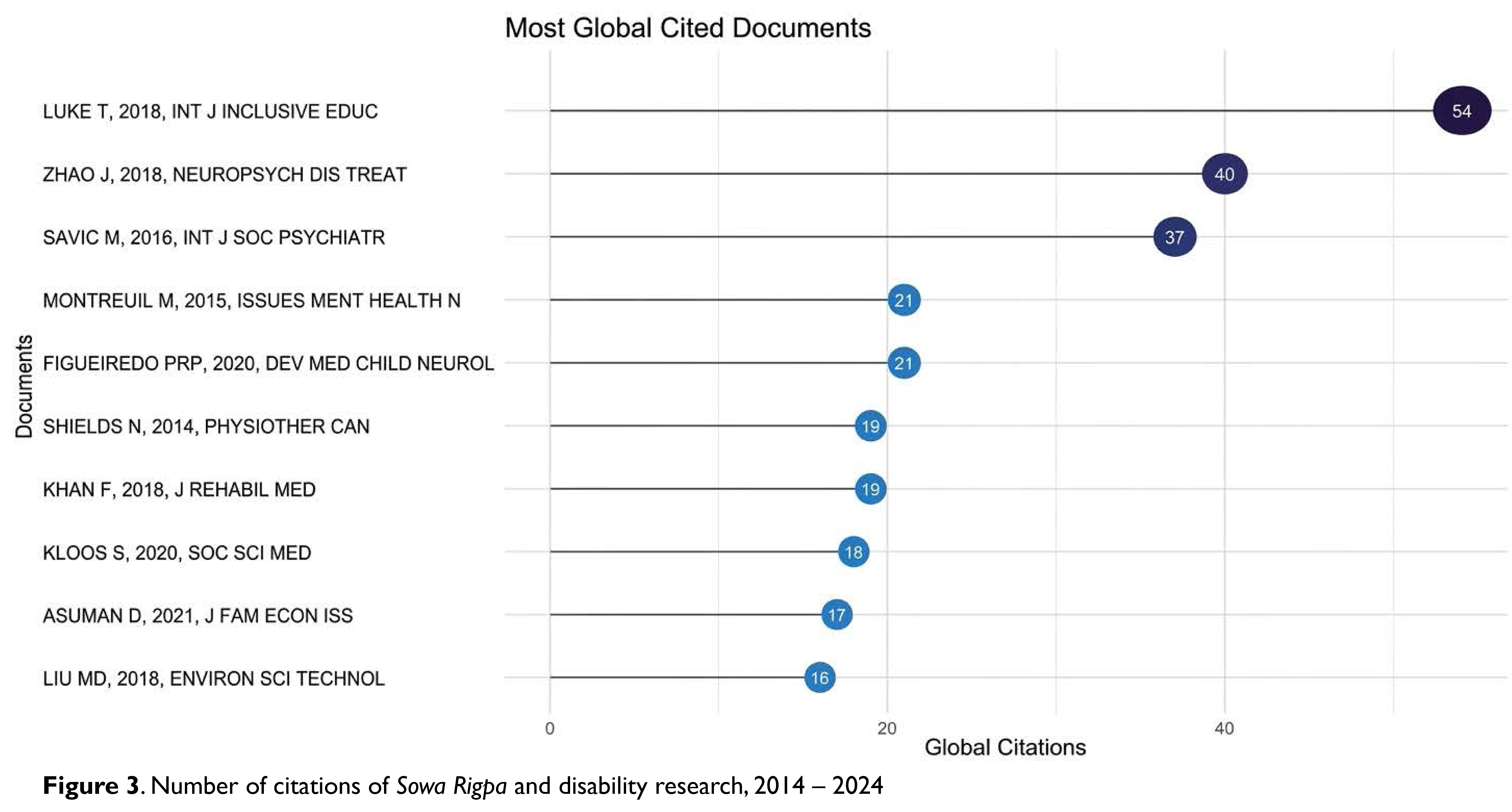
There were 306 authors who contributed their research papers to more than 60 sources. This section depicts the 10 most globally cited documents in Figure 3. Referring to this figure, the works of Luke and Grosche in the International Journal of Inclusive Education was the highest cited study in the dataset with 54 citations [9]. The average citation of top ten most globally cited documents was 26.2.
Country-wise scientific production
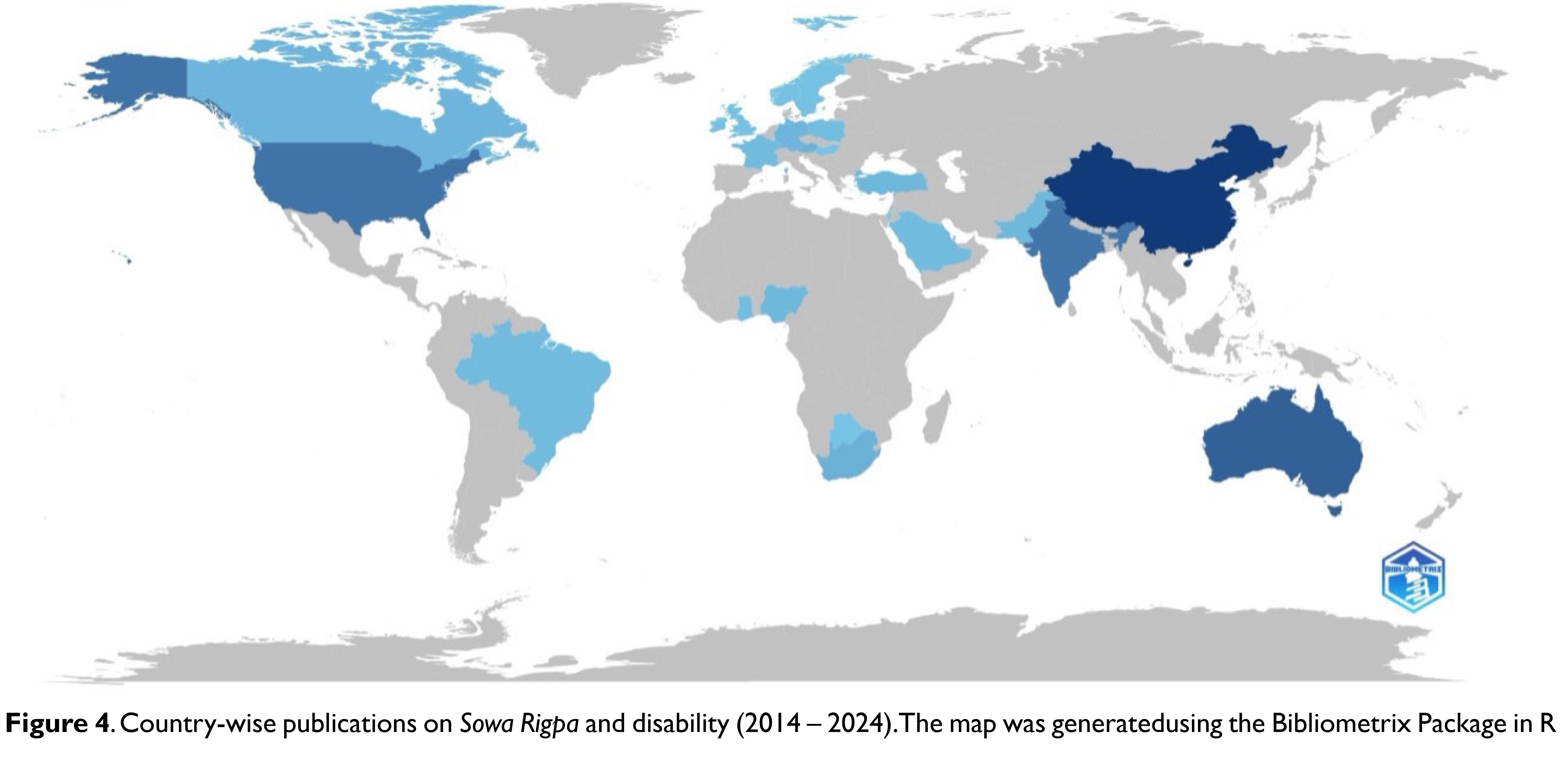
Country-wise scientific production on disability and Sowa Rigpa is illustrated in Figure 4, using a different shade of blue colour gradient. A very dark shade of blue indicates the highest number of scientific productions, whereas light blue indicates the least production, and grey indicates no publication. China exhibits the highest number of publications, followed by Australia. India and the USA fall in the medium production category for scientific publication, with medium blue shades. Moderate contributions were observed from Canada and Brazil, while several African and European countries demonstrated relatively lower publication outputs. Countries indicating no publication are represented in grey shades.
Topic of interest through author’s keywords
Among the published articles, keywords such as Tibetan medicine (15), disability (9), persons with disabilities (5), and Sowa Rigpa (5) were the most frequently used keywords. Words such as inclusion (3), Traditional medicine (3), human rights (3), education (2) and AYUSH (2) were used less frequently. Table 1 shows the frequency of keywords used in the articles.
DISCUSSION
The key findings of this analysis indicated that Sowa Rigpa- and disability-related studies were published across disciplines, showing the interconnectedness of this theme across medicine, psychology, culture, religion, education, and society. One noticeable finding is that the articles were published across the interdisciplinary journals, while very few were published in the journals dedicated to traditional medicine or indigenous healthcare systems. This publication pattern suggests that studies related to Sowa Rigpa and disability are disseminated through broader religion, health, rehabilitation, and social science platforms rather than specialised traditional medicine journals. Such interdisciplinary dissemination demonstrates increasing academic engagement but also reflects the limited integration of indigenous medical knowledge into disability and rehabilitation scholarship.
Geographical concentration of research is understood through country-wise scientific production, where China upholds the highest number of publications. This pattern may partly be explained by the transnational development of the Sowa Rigpa industry, where China accounted for approximately 98% of the Asian market with an estimated sales value of 677 million USD in 2017, while India contributed around 11 million USD [10]. Strong institutional support, commercial development, and policy recognition may therefore have facilitated greater research productivity in China compared with other countries in the Trans-Himalayan region.
A study conducted in 2015 in Ladakh, India, reported that 46% of the population preferred traditional medicine while 22% relied on both Sowa Rigpa and the allopathic system [11], which may have contributed to growing scholarly interest in exploring disability research within the discourse of Sowa Rigpa. The same study also documented beliefs associating illness with black magic. While this bibliometric analysis does not establish any association between disability and such beliefs, it does demonstrate that cultural and spiritual lenses continued to interpret illness and disability.
Table 1. Topic of interest from author’s keywords on research articles on Sowa Rigpa and disability
| Terms | Frequency |
|---|---|
| Tibetan medicine | 15 |
| Disability | 9 |
| Persons with disabilities | 5 |
| Sowa Rigpa | 5 |
| India | 4 |
| China | 3 |
| Inclusion | 3 |
| Resilience | 3 |
| Tibet | 3 |
| Traditional medicine/td> | 3 |
| Africa | 2 |
| AYUSH | 2 |
| Buddhism | 2 |
| Death | 2 |
| Education | 2 |
| Exercise | 2 |
| Human rights | 2 |
| Individualised funding | 2 |
| Intellectual disability | 2 |
| Mental health | 2 |
| Qualitative research | 2 |
Mental health stands out from the retrieved literature, as it is one of the philosophical foundations of Sowa Rigpa. Health is understood as a result of balance in both Nyespa-gSum and Jung-wa-lna; imbalances contribute to physical and psychological disorders rather than disability itself. Disturbance in the flow of rlung, one of the three nyespa-gSum, results in disturbance in the human mind. Mental illness is listed as a disability in the Rights to Person with Disabilities Act 2016 in India [12]. Based on this philosophical basis, Sowa Rigpa may have a larger role to play in improving mental health.
Additionally, existing literature reported that all physical and psychological disorders were treated by traditional healers in Muslim community (Akhons) and in Buddhist (Amchis) including dental, acid peptic disease, depression, upper respiratory, headache, osteoarthritis [6]. These practitioners of Sowa Rigpa have to have some characteristics such as kindness, diligence, intelligent, trustworthiness, social awareness, and practical experiences [13]. All these attributes are essential in building rapport with persons with disabilities (PwD) and enhance the doctor- patient relationship, without discrimination or prejudice. The treatments are provided free of cost, while the patient or their family members helps with farming activities of the Amchi [13].
In this bibliometric analysis, there was a gross underrepresentation of rehabilitation research. Caregivers continue to consult Amchi and Akhons for treatment, including diagnosing disability at an early stage in a child [13,14]. With the expansion of modern healthcare facilities and support for diagnosis and care of PwD, it is integral to engage actively with the traditional medicine or Sowa Rigpa practitioners to address the needs of people. Greater interdisciplinary collaboration between Sowa Rigpa practitioners with rehabilitation professionals, public health researchers, and social workers could strengthen the evidence base for integrating traditional healthcare with disability services.
Limitations
One limitation of our study was that records were extracted only from the Web of Science database and used only English-language articles. As this was an empirical study, future research is recommended for a comprehensive understanding of the trends of publications related to disability and Sowa Rigpa.
CONCLUSIONExisting literature on Sowa Rigpa and disability is disseminated across interdisciplinary journals and is geographically dominated by a few countries. The findings suggest a growing academic interest in exploring traditional healing practices for disability and mental health. Future research should delve deeper into the integration of Sowa Rigpa with modern rehabilitation approaches to enhance the well-being of persons with disabilities.
Acknowledgements
We would like to acknowledge the Department of English, Rajiv Gandhi University, Arunachal Pradesh, for providing us with the opportunity to present this paper at the Two Days National Seminar on “Reviving and Reimagining Indigenous Knowledge Traditions in Contemporary Discourses” held on 27 – 28 February 2025. The discussion and debates during the seminar contributed to the refinement and scholarly development of this paper.
Declarations
Ethics approval and consent to participate.
Not applicable
Consent for publication
Not applicable
Competing interests
The authors declare no competing interests.
Funding
This study received no specific grant from any funding agency
Availability of data materials
All public sources of data have been cited in this article.
Declaration of Artificial Intelligence Use
AI-assisted tools (such as Claude, Grammarly and ChatGPT) were used solely to improve language, grammar, and readability of the manuscript. The authors reviewed and edited all AI-assisted content and take full responsibility for the accuracy and integrity of the final manuscript.
Author contributions
Conceptualization, Methodology, Formal analysis, Investigation, Data curation, Writing – original draft, Visualization: RY
Methodology, Software, Formal analysis, Investigation, Data curation, Visualization: MMA
Investigation, Writing – review & editing, Visualization: AY
Validation, Writing – review & editing, Supervision: AS
Received: 28 April, 2026, Revised: 29 July, 2026, Accepted:29 July, 2026, Published online: 10 August, 2026References
- Gurmet P. Sowa-Rigpa : Himalayan art of healing. Indian Journal of Traditional Knowledge. 2004;3: 212–218. Available: https://l1nq.com/ qw2cl29
- World Health Organization. International classification of functioning, disability and health : ICF. Geneva: World Health Organization; 2001. Available: https://l1nq.com/epwvhel
- United Nations. Convention on the rights of persons with disabilities and optional protocol. New York; 2006 Dec. Available: https://sl1nk. com/6yxqks9
- Ghai A. Rethinking disability in India. 1st ed. India: Routledge; 2015. Available: https://l1nq.com/0n4bjky
- Helander E. Prejudice and dignity : an introduction to community- based rehabilitation. New York: UNDP, Interregional Programme for Disabled People; 1993. Available: https://digitallibrary.un.org/record/ 696355?ln=en&v=pdf
- Deane S. rLung, mind, and mental health: the notion of “wind” in Tibetan conceptions of mind and mental Illness. J Relig Health. 2019;58: 708–724. doi:10.1007/S10943-019-00775-0
- Anand S, Sonar RM, Jain K. View of traditional knowledge research in India: A bibliometric-based review and thematic analysis. Indian Journal of Traditional Knowledge. 2025;24: 275–287. doi:10.56042/ijtk. v24i3.9491
- Aria M, Cuccurullo C. Bibliometrix: an R-tool for comprehensive science mapping analysis. J Informetr. 2017;11: 959–975. doi:10.1016/J. JOI.2017.08.007
- Lüke T, Grosche M. What do I think about inclusive education? It depends on who is asking. Experimental evidence for a social desirability bias in attitudes towards inclusion. International Journal of Inclusive Education. 2017;22: 38–53. doi:10.1080/13603116.2017.1348548
- Kloos S, Madhava H, Tidwell T, Blaikie C, Cuomu M. The transnational Sowa Rigpa industry in Asia: new perspectives on an emerging economy. Soc Sci Med. 2020;245. doi:10.1016/j.socscimed.2019.112617
- Rather GM. Traditional medical therapy in rural Ladakh- a regional analysis. Int J Health Sci Res. 2015;5: 470. Available: https://www.ijhsr. org/IJHSR_Vol.5_Issue.6_June2015/65.pdf
- Government of India. The Rights of Persons with Disabilities Act, 2016. The Gazette of India Extraordinary, 49 India; Dec 27, 2016. Available: https://sl1nk.com/advmtu3
- Angmo K, Gailson L, Adhikari B, Rawat G, Bhat J, Bussmann RW, et al. Prevailing traditional health care services in Western Ladakh, Indian Trans-Himalaya. Ethnobotany Research and Applications. 2022;24: 1–12. doi:10.32859/era.24.22.1-12
- Adhikari BS, Angmo K, Rawat GS. Sowa-Rigpa : a healthcare practice in Trans-Himalayan region of Ladakh, India. SDRP J Plant Sci. 2017;2: 45–52. doi:10.25177/JPS.2.1.3