Sangay Thinley1 ,
Jigme Nidup1
,
Jigme Nidup1
1Department of Traditional Medicine, Eastern Regional Referral Hospital, Mongar, Bhutan
Corresponding author:Jigme Nidup, Department of Traditional Medicine, Eastern Regional Referral Hospital, Mongar, Bhutan.
Email: gmenidup@gmail.com
DOI: https://doi.org/10.47811/jtmsr.0033070727
Copyright © The Authors. Journal of Traditional Medicine and Sowa Rigpa published by the Faculty of Traditional Medicine, Khesar Gyalpo University of Medical Sciences of Bhutan. Formerly published as Bhutan Sorig Journal.
This is an open access article under the CC BY-NC-ND license.

INTRODUCTION
Thruelkhor, a classical Sowa Rigpa affusion therapy used to promote mental relaxation and restore mindbody balance, was introduced into outpatient services within the Department of Traditional Medicine at the Eastern Regional Referral Hospital (ERRH), Mongar, on 01 January 2026. The introduction is part of a broader effort to strengthen traditional medicine within Bhutan’s healthcare system. The ERRH is one of the Bhutan’s three tertiary hospitals, serving the population of seven eastern dzongkhags. Traditional Medicine and biomedical services are integrated within the same hospital infrastructure, allowing patients to access both systems of care under one roof.
The decision to offer Thruelkhor followed clinical observation of increasing outpatient presentations for anxiety, insomnia, occupational stress, mild mood disturbance, and a corresponding demand for safe, non-invasive treatment options that complement the existing biomedical care [1]. This local trend is consistent with national evidence, which increasingly identifies mental health as a public health priority in Bhutan. Community-based surveys and health system reviews have reported a growing burden of anxiety, depression, and stress-related disorders, alongside persistent gaps in access to mental health services, particularly outside the major urban centres [2]. In addition, the World Health Organisation’s Traditional Medicine Strategy encourages integration of such practices into national health systems, conditional on the generation of context-specific data on their safety and efficacy. Although Thruelkhor has been practiced in Bhutan for decades, systematic hospital-based documentation of its use, indications, and outcomes has been lacking. In this News, we report the introduction of Thruelkhor at ERRH.
HOW IS THE THERAPY DELIVERED ?
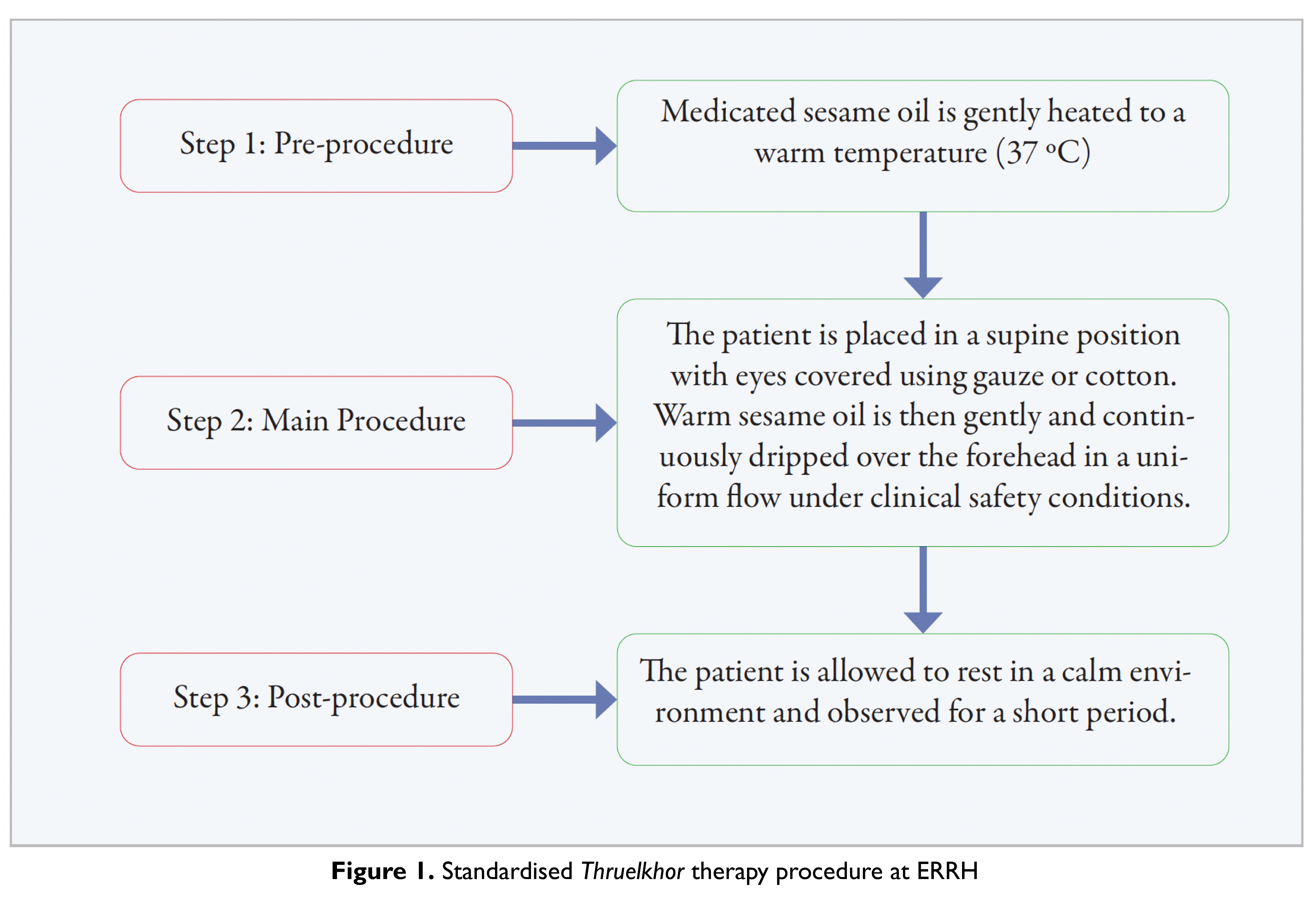
Each patient undergoes a baseline clinical assessment by the attending Drungtsho, who reviews the presenting symptoms, medical history, and current biomedical treatment before considering the patient suitable for the therapy. Clinical indications for Thruelkhor, loosely translated, include anxiety (Sem-duk), insomnia (Nyi-yerwa), migraine (Go-nad), giddiness (Gozi- khorwa), and stress-related disorders (Sem-ngyel). Patients with acute infection, open scalp or forehead lesions, uncontrolled hypertension, or known sesame oil allergy are excluded, and those on concurrent biomedical treatment for their presenting condition are cross-referred between traditional and modern medicine practitioners to ensure coordinated care. The length and duration of the therapy are determined by the clinical condition and therapeutic response. The standard protocol in Bhutan is 45 minutes once daily over three to seven consecutive days. The standardised sequence of Thruelkhor includes oil preparation, patient positioning, therapy delivery, and post-care intended to ensure consistency, safety, and quality of care across sessions (Figure 1).
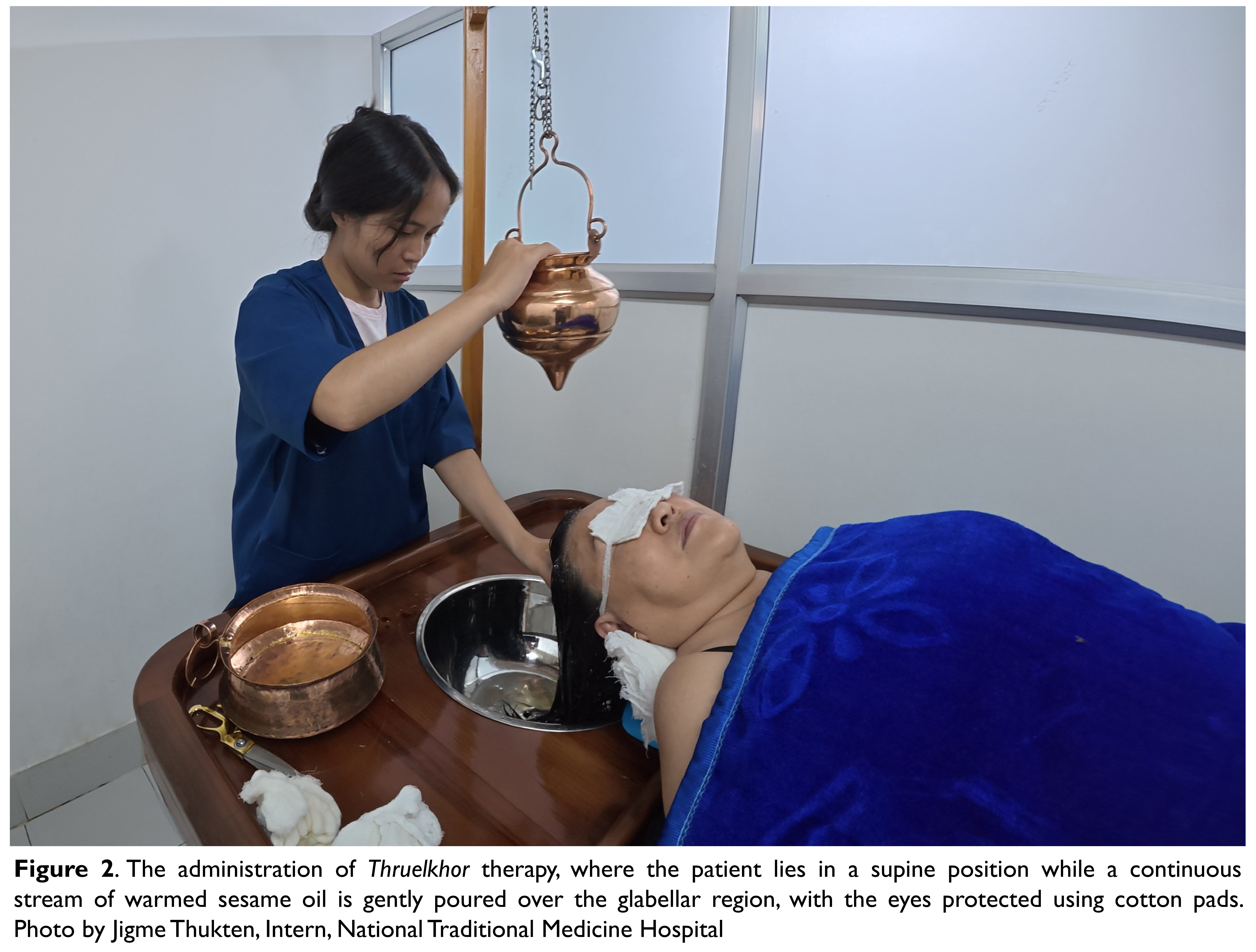
As shown in Figure 2, the therapy involves continuous pouring of warm (37 °C) medicated sesame oil (Tilnum) over the glabellar region – the site is traditionally termed as the “third eye” – with the aim to pacify wind energy (rLung) and restoring psycho-physiological balance. In Sowa Rigpa theory, rLung governs mental activity and nervous system function, and its imbalance results in stress-related and neurological complaints. Similar practice in Ayurveda, Shirodhara, has been associated with increased alpha electroencephalographic activity, reduced perceived stress, and improved sleep quality, potentially through parasympathetic activation, though the evidence base remains limited by small sample sizes and heterogeneous methodologies [3,4].
EARLY CLINICAL EXPERIENCE
Between 1 January and 30 April 2026, 40 patients – 11 males and 29 females – received Thruelkhor at ERRH. Migraine headache was the most common indication (20 patients), followed by giddiness (10), stress or tension headache (6), and insomnia (4). Patients received three to seven sessions depending on their condition (Table 1). Outcomes were assessed through an anonymous, self-administered questionnaire covering symptom severity, sleep quality, pain intensity, and the overall well-being, together with routine clinical observation during the treatment period. Independent and anonymous completion of the questionnaire was intended to limit courtesy and social desirability bias.
Table 1. Patient-reported symptom changes following Thruelkhor therapy, 1 January – 30 April 2026
| Disease/Health Problem |
Sex | Session(s) | Patient's Reporting | |
|---|---|---|---|---|
| M | F | |||
| Giddiness | 3 | 7 | 3 | Improvement in symptoms |
| Migraine headache | 5 | 15 | 7 | Improvement in symptoms |
| Insomnia | 1 | 3 | 3 | Improvement in sleep quality |
| Stress/tension headache | 2 | 4 | 5 | Improvement in symptoms |
All 40 patients reported subjective improvement of their symptoms, including reduced symptoms severity, better sleep quality, lower intensity of headache, and greater relaxation and well-being. Outcomes broadly matched the presenting indication. For example, patients with migraine and tension headache most often described reduced pain intensity and frequency, while patients with insomnia reported improved sleep onset and continuity. Likewise, patients presenting with giddiness reported fewer and less severe episodes in addition to overall relaxation.
INTERPRETING THE FINDINGS
The reported outcomes were not assessed using validated outcome measures or compared with a control group. Therefore, these findings should be interpreted as preliminary clinical observations rather than evidence of efficacy.
Yet, outcomes were consistent with the claims of Sowa Rigpa that the Thruelkhor has calming and restorative effects, concomitant to reported physiological effects of Shirodhara in Ayurveda [4]. The consistency of improvement across all four indication groups is notable. However, in the absence of a control arm, it cannot be determined whether the observed improvement reflects a specific therapeutic effect or the influence of expectation, practitioner attention, or the relaxing clinical environment in which the therapy is delivered.
The introduction of Thruelkhor represents a continuous initiative to integrate a traditional medicine into structured, hospital-based care, and deliver a non-pharmacological and non-invasive option for patients with stress-related and neurological disorders. It also reflects Bhutan’s continuous commitment to deliver free basic healthcare – both modern and traditional medicine – as mandated in the constitution.
Whether Thruelkhor offers benefits beyond expectation or generalised relaxation is a question that will require a larger, controlled study with validated outcome measures and longer follow-up. Meanwhile, the early experience at ERRH demonstrates the feasibility of delivering this traditional therapy within a tertiary hospital setting alongside biomedical care and provides an initial clinical record on which future studies can evaluate the efficacy of Thruelkhor.
Acknowledgements
The authors acknowledge the staff of the Department of Traditional Medicine, ERRH, Mongar, and all participating patients.
Declarations
Ethics approval and consent to participate.
Not applicable
Consent for publication
Not applicable
Competing interests
The authors declare no competing interests.
Funding
This study received no specific grant from any funding agency
Availability of data materials
All relevant data sources are cited in this article.
Declaration of Artificial Intelligence Use
AI-based tools (such as Claude and ChatGPT) were solely used to improve language, grammar and readability of this article. All scientific content, data interpretation, and conclusions are the work of the authors.
Author contributions
Conceptualization, investigation, resources: ST, JN
Writing – original draft, review & editing: JN
Received: 31 March, 2026, Revised: 08 September, 2026, Accepted:08 September, 2026, Published online: 24 September, 2026References
- Eastern Regional Referral Hospital. Eastern Regional Referral Hospital annual report 2024. Mongar, Bhutan: Eastern Regional Referral Hospital; 2025. https://errh.gov.bt/wp-content/uploads/2025/09/Eastern- Regional-Referral-Hospital-Annual-Report-2023.pdf
- Pelzang R. Mental health care in Bhutan: Policy and issues. WHO South East Asia J Public Health. 2012;1(3):339–346. https://pubmed.ncbi. nlm.nih.gov/28615560/
- Tokinobu A, Yorifuji T, Tsuda T, Doi H. Effects of Ayurvedic Oil-Dripping Treatment with Sesame Oil vs. with Warm Water on Sleep: A Randomized Single-Blinded Crossover Pilot Study. J Altern Complement Med. 2016;22(1):52-8. doi: 10.1089/acm.2015.0018.
- Dhuri KD, Bodhe PV, Vaidya AB. Shirodhara: A psycho-physiological profile in healthy volunteers. J Ayurveda Integr Med. 2013;4(1):40-4. doi: 10.4103/0975-9476.109550.